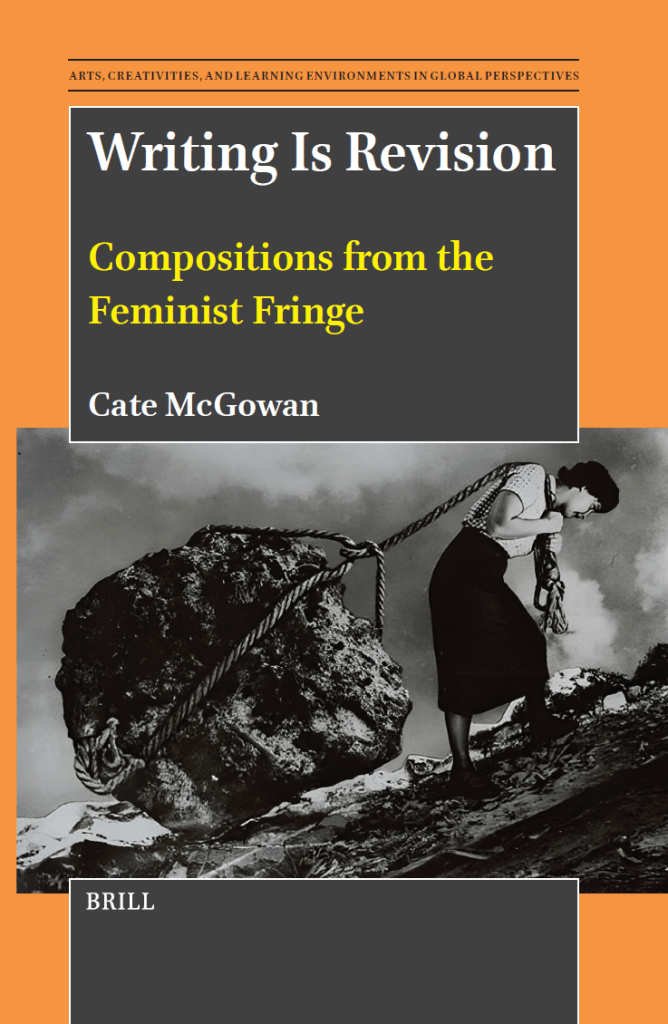
Writing Is Revision: Compositions from the Feminist Fringe traces the shape of a life spent writing at the edges—those borderlands where scholarship and story, theory and memory, high diction and Southern vernacular meet and braid themselves into something incandescent. In these essays, Cate McGowan turns the braided form into an instrument of discovery, weaving personal narrative with feminist criticism, rhetorical inquiry, and the restless movement of a mind that refuses to settle for a single way of knowing.
The book opens with the questions that have stalked her since girlhood: What does it mean to speak in a world determined to speak for you? How does a woman write herself into being when language itself has been formed without her in mind? From the first pages, McGowan pulls readers into stories of family, class, beauty, danger, and defiance—scenes lit by memory’s strange electricity—before interlacing them with the ideas that helped her survive. Linda Nochlin, Laura Cereta, Judith Butler, and Rafia Zakaria appear not as distant theorists but as touchstones in a lineage of women who push back against the machinery of patriarchy. Michel Foucault’s examinations of power, Gloria Anzaldúa’s code-switching across languages, and the everyday resistance mapped by James C. Scott, Mona Lilja, and Stellan Vinthagen deepen her ongoing exploration of who gets to speak and at what cost.
McGowan does not merely cite these thinkers; she walks beside them, letting their voices echo against her own memories—of poverty, of danger, of desire, of hard-won independence. Her account of surviving a violent relationship in New York becomes a counterpoint to her meditations on literary resistance. Her early, hungry years in academia chime against her analysis of exclusion in discourse. And always, her writing returns to craft: to the slow, recursive labor of revision, to the startling clarity that emerges only after you cut your way through the thicket of a draft.
Part II opens a backstage door to her own fiction. She writes candidly about how her stories take shape—through fragments, associative leaps, hauntings, and fabulist disruptions. Walter Benjamin’s drift through the Paris arcades, Anne Carson’s fragment-poetics, Ursula K. Le Guin’s carrier-bag theory, and the playful shell-swapping of the hermit-crab story all become companions as she explains how her fiction grows from the scraps and shards of daily life. She writes about characters who outrun her, plots that reveal themselves only in hindsight, and the unsettling ways memory and imagination shadow each other on the page.
Throughout the book, McGowan’s voice moves between tenderness and bite. She is funny, sharp, vulnerable, and deeply aware of the stakes for women who speak plainly in a world still shaped by old hierarchies. Her prose carries the weight of lived experience but also the bright churn of possibility. She writes about grief—about the sorrow of finishing a story and letting it go—but she also writes about the joy of discovering what a sentence can hold when you let it breathe in more than one direction.
Writing Is Revision is, at its heart, an argument for writing as a mode of survival. It is a book for anyone who has lived on the margins, anyone who has revised herself again and again in the face of silence or dismissal, anyone who believes the written word can still provoke, soothe, astonish, and transform. McGowan offers not a manual but a companion—an open hand inviting readers into the strange, luminous tangle of a mind making meaning against the grain.
Preview excerpt: Descanso
Website design by Cate McGowan ©; all rights reserved, 2025.
<div id="statcounter_image" style="display:inline;"><a
title="website statistics" href="https://statcounter.com/"
class="statcounter"><img
src="https://c.statcounter.com/10326524/0/80bd92c3/1/"
alt="website statistics"
referrerPolicy="no-referrer-when-downgrade" /></a></div> Cate McGowan